

Individual Therapy · Los Angeles & Online California
Individual Therapy in Los Angeles
— heal somewhere steady
Calm, rooted, compassionate care for Californian individuals
Are you feeling overwhelmed?
Individual therapy can be a place to slow down, feel less alone, and begin making sense of what has been hard to carry by yourself.
At Grayslate Therapy, we offer individual therapy in Los Angeles and online across California for adults navigating anxiety, trauma & grief, ADHD & identity questions, burnout, relationship patterns, life transitions, and emotional overwhelm. You don’t have to arrive with everything figured out. Many people begin therapy with only a sense that something feels off: they feel stuck, disconnected, reactive, numb, exhausted, or tired of repeating the same painful patterns.
Our approach is warm, affirming, collaborative, and depth-oriented. Therapy at Grayslate is not about judging you, fixing you, or telling you who to be. It is about creating enough safety to understand yourself more clearly, reconnect with your emotions, and build more choice in how you relate to yourself and others.
If you are looking for an individual therapist in Los Angeles, we invite you to begin with a free 20-minute consultation.


Here for you, no matter where you’re at
You Don’t Have to Know Exactly What’s Wrong to Start Therapy
Many people wait to start therapy because they think they need a clear reason, a diagnosis, or a crisis. But therapy often begins with something more subtle.
Maybe you are functioning on the outside but feel overwhelmed inside. Maybe you keep overthinking conversations, shutting down in conflict, people-pleasing, masking, procrastinating, or feeling like your emotions are either too much or completely inaccessible. Maybe grief, trauma, family expectations, identity questions, burnout, or relationship stress have made it harder to feel grounded in yourself.
There’s no such thing as “not serious enough” in the therapy room, and you don’t have to prove your reason for reaching out.
Whatever you’re here for, individual therapy gives you a space to pause, name what has been happening, and understand the patterns that may be shaping your reactions, relationships, and sense of self.
For some people, therapy helps with anxiety, depression, trauma, or ADHD.
For others, it helps them understand why they feel disconnected, why certain relationships feel so difficult, or why they keep abandoning their own needs. If you are wondering whether therapy is meant for someone like you, our guide to who therapy helps explores this more deeply.
What Individual Therapy Is and What It Isn’t
Individual therapy is one-on-one care with a trained therapist. It’s a confidential, structured relationship where you can explore your emotions, experiences, relationships, identity, stressors, and patterns with support.
Therapy is not the same as getting advice from a friend. Neither is it a place where someone tells you what to do, diagnoses your personality, or decides what your life should look like. It’s also not just venting, though being able to speak honestly can be deeply important.

Understand Your Experience
In individual therapy, you and your therapist work together to understand what is happening beneath the surface. This may include exploring emotional patterns, family-of-origin experiences, attachment wounds, trauma responses, nervous system activation, coping strategies, boundaries, identity, and the ways you learned to survive difficult environments.

Implement Practical Tools
Sometimes therapy includes practical tools to implement in your day-to-day. Sometimes it involves slowing down and feeling something you’ve tried to avoid. And sometimes it means noticing how old protective strategies are no longer helping in the way they once did.

Collaborate and Heal
The process is collaborative. A good therapist does not take over your life; they help you listen to yourself more clearly, compassionately, and honestly. For a deeper explanation of the process, check out our guide to how individual therapy actually works. We walk through what makes therapy different from advice or ordinary conversation in detail.
Does this sound like you?
What Individual Therapy Can Help With
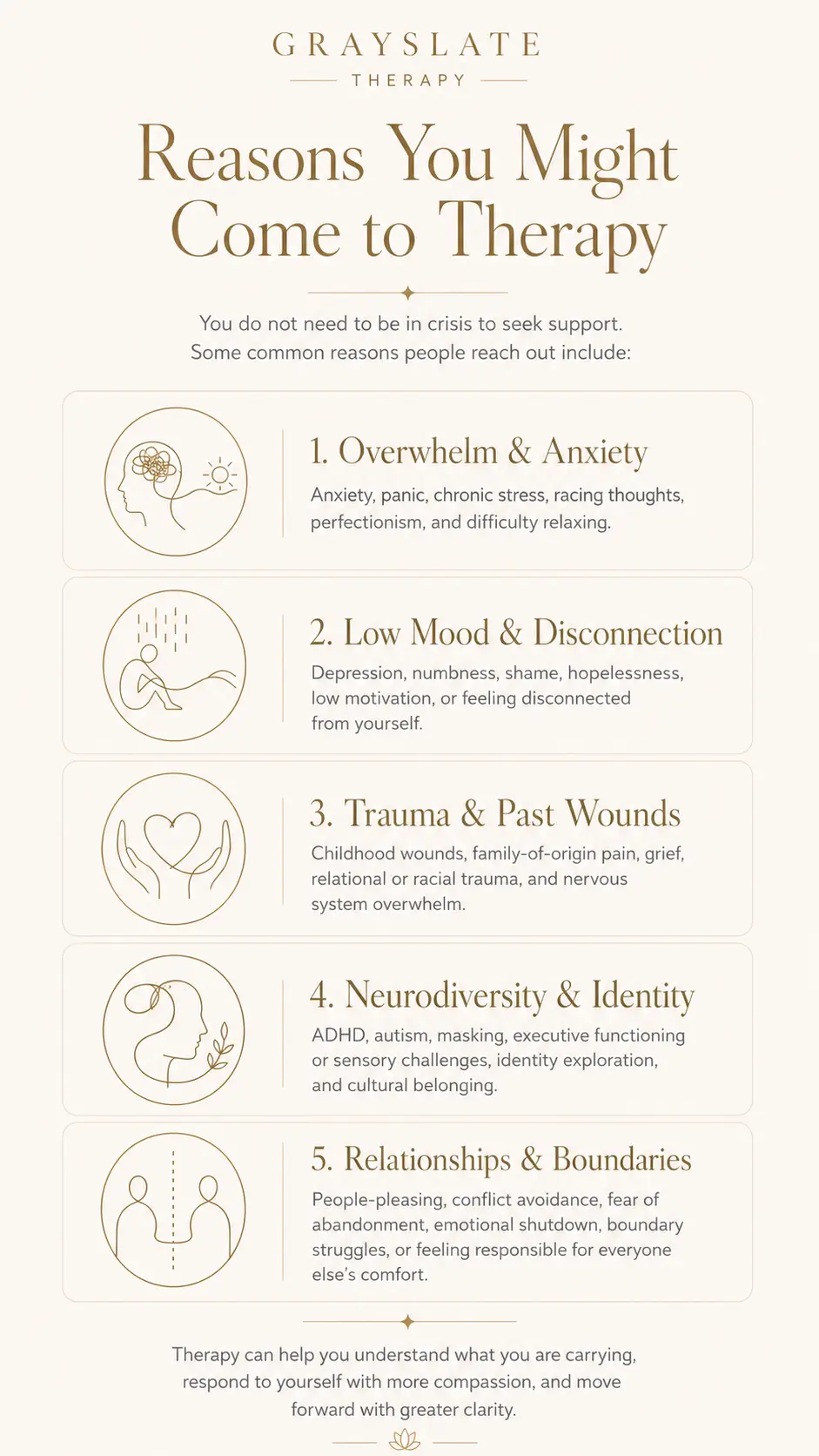
People come to individual therapy for many reasons. Some are looking for relief from symptoms that have become hard to manage. Others want to understand themselves, heal from painful experiences, or change patterns that keep showing up in their relationships, work, family, or inner life.
Individual therapy at Grayslate Therapy may support you with:
- Anxiety, panic, chronic stress, racing thoughts, perfectionism, and difficulty relaxing;
- Depression, numbness, low motivation, shame, hopelessness, or feeling disconnected from yourself;
- Trauma, childhood wounds, family-of-origin pain, racial trauma, relational trauma, grief, and nervous system overwhelm;
- ADHD, autism, masking, executive functioning challenges, sensory needs, emotional intensity, and the exhaustion of feeling misunderstood;
- Identity exploration, sexuality, gender, cultural belonging, immigrant family dynamics, code-switching, and the pressure to make yourself more acceptable to others.
- Relationship patterns, people-pleasing, conflict avoidance, boundary struggles, fear of abandonment, emotional shutdown, or feeling responsible for everyone else’s comfort.
For clients carrying trauma, grief, or painful relational experiences, Grayslate also offers specialist trauma therapy.
For ADHD, autism, masking, sensory needs, or executive functioning concerns, our neurodivergent-affirming therapy may be a supportive fit.
Therapy can also help with burnout, imposter syndrome, major life transitions, creative blocks, loneliness, or the grief of realizing that what once helped you survive may now be keeping you small.
Starting Individual Therapy at Grayslate Therapy

Book a free consultation
You can start by booking a free 20-minute consultation. This call gives you a chance to share a little about what you are looking for, ask questions, and get a sense of whether Grayslate Therapy feels aligned with your needs.

Get matched with a therapist
We consider therapist fit carefully. This may include your goals, schedule, identity preferences, clinical needs, therapy style, and whether you are looking for support with trauma, neurodivergence, relationships, anxiety, grief, identity, or emotional patterns.

Begin sessions in Los Angeles or online
Once you are matched, you can begin individual therapy in person in Los Angeles or online anywhere in California. Your therapist will help you settle into the process, clarify goals, and move at a pace that feels supportive.
You don’t have to know exactly what to say before you begin.
You only need enough curiosity, hope, or determination to take the next step.
Your Therapists
Our Individual Therapists in Los Angeles

Grazel Garcia, LMFT
Licensed Marriage and Family Therapist, 15+ years. Certified EFT supervisor candidate. Specializes in interracial couples, LGBTQ+, trauma, grief, Brainspotting.

Sarah Liang, AMFT, APCC
Neurodiverse and queer-affirming therapist specializing in Emotionally-Focused Couples Therapy (EFCT). Relational, systems-informed approach.

Arami James, AMFT
Culturally responsive therapist working with individuals and couples on interracial and intercultural relationship dynamics — fostering understanding and connection.

Tiffany Cuevas, AMFT
LGBTQIA+ affirming therapist specializing in identity, relationships, and personal growth. Compassionate, non-judgmental space for couples exploring relationship dynamics.

Dr. Tyler Howard, PsyD
Clinical Psychologist specializing in neuropsychological testing and trauma-informed care. LGBTQIA+ and neurodiverse-affirmative psychotherapy for individuals and couples.

A Therapy Approach Rooted in Emotional Safety, Attachment, and Depth
At Grayslate Therapy, individual therapy is grounded in the belief that people heal best when they feel emotionally safe enough to be honest.
That does not mean therapy is always easy. Meaningful therapy may bring up grief, anger, fear, shame, longing, or memories you have spent years trying to outrun. But the work should never feel forced, shaming, or disconnected from your pace. Our trauma-informed therapists help you approach difficult material with care, steadiness, and respect for your nervous system.
All of our therapists draw from Emotionally Focused Therapy, an attachment-based approach that helps clients understand emotional patterns with compassion rather than shame. From this perspective, emotions are not problems to eliminate: They’re signals. They can show us where we feel threatened, where we long for connection, where we learned to protect ourselves, and where something important needs attention.
Our work is also identity-conscious and culturally responsive. We support clients who are BIPOC, LGBTQ+, neurodivergent, immigrants, children of immigrants, creatives, caregivers, cycle-breakers, and people who have had to become very skilled at masking or adapting to environments that did not fully see them.
Individual therapy can help you build emotional language, self-trust, clearer boundaries, and more secure ways of relating. The goal is not to become a different person. It’s to become more connected to yourself – to become more you!.

Grayslate is an exceptional, culturally attuned practice that truly embodies compassion and depth. Grazel and her team create a space that honors each client’s unique story while integrating relational, trauma-informed, and liberatory approaches. Their commitment to inclusivity, accessibility, and social justice is evident in every detail, from their bilingual, LGBTQIA+-affirming care to their work with creatives and diverse communities. This is a practice that genuinely listens, heals, and empowers.
Kate Behzadi, LMFT
It’s not as scary as it sounds
What Actually Happens in Therapy Sessions
If you have never been to therapy before, it is normal to wonder what you are supposed to say.
In the first few sessions, your therapist may ask about what brings you in, what has been feeling difficult, what support you are hoping for, and what parts of your history feel important to understand. You may talk about relationships, family, work, identity, trauma, symptoms, stress, or patterns you have noticed but cannot fully explain yet.
You don’t have to tell your whole life story at once. You don’t have to be perfectly articulate. You don’t have to perform or have incredible insights right away.
As therapy continues, sessions may move between what is happening now and where those patterns began. Your therapist may ask questions, reflect themes, offer psychoeducation, help you notice emotions in your body, or slow down a moment that seems important. Sometimes the work is practical. Sometimes it is emotional. Often, it is both.
Therapy at Grayslate is structured, but it is not scripted.
The process responds to you: your goals, your pace, your capacity, and what begins to emerge as trust develops. If the unknown feels intimidating, this guide to what actually happens in therapy sessions can help make the process feel less mysterious.
All our individual therapy Services
Explore our individual therapy services
Some clients benefit from more specialized support depending on what they are carrying.
These related services are part of Grayslate Therapy’s individual care network.
Trauma Therapy
For clients carrying trauma, grief, family-of-origin wounds, racial trauma, relational trauma, dissociation, hypervigilance, shame, or nervous system overwhelm. Trauma therapy can help you move at a pace that respects both your pain and your capacity.
Neurodivergent Folx
For ADHD, autism, masking, executive functioning struggles, sensory needs, emotional intensity, rejection sensitivity, burnout, and the exhaustion of being misunderstood. Neurodivergent-affirming therapy does not treat your brain as a problem to fix.
Emotionally-Focused Therapy
For clients who want to understand emotional patterns, attachment wounds, shutdown, reactivity, fear, longing, and the deep human need for safer connection. Emotionally Focused Therapy helps make sense of what happens beneath the surface.
If you are unsure which path is right for you,
we can help you decide where to start.
We take our role seriously
Why Fit, Boundaries, and Trust Matter
The relationship between you and your therapist matters deeply. Therapy asks for honesty, vulnerability, and reflection, which means the space needs to feel safe enough for you to bring your real questions, doubts, reactions, and needs.
A ‘good fit’ doesn’t mean your therapist always says exactly what you want to hear. It means you feel respected, taken seriously, and able to speak up when something does not feel right. You are allowed to ask questions. You are allowed to move slowly. You are allowed to notice whether a therapist’s approach, communication style, and areas of experience feel supportive for you.
Boundaries are also part of good therapy. Therapy can feel deeply personal, but it is not friendship. It’s a professional relationship designed around your care, growth, privacy, and autonomy. Clear boundaries help protect the work. They create consistency, reduce confusion, and support ethical care.

At Grayslate Therapy, trust is built through warmth and professionalism together. Confidentiality, informed consent, and collaboration all matter. For clients who want to better understand what ethical care should feel like, read our guide to therapy boundaries, ethics, and professional standards.
How Often You’ll Come to Therapy and How Progress Happens
Most individual therapy sessions at Grayslate are 50 minutes. Many clients begin with weekly therapy because consistency helps the work build momentum. When sessions happen regularly, you and your therapist have more continuity, more context, and more opportunity to notice patterns as they unfold.

Some clients may benefit from 75- or 90-minute sessions, especially when working with complex trauma, intense life transitions, or deeper emotional processing. Others may eventually move to biweekly sessions when they feel more stable, are maintaining progress, or need a different pace for logistical or financial reasons.
There is no single timeline that fits everyone. Frequency depends on your goals, distress level, availability, finances, nervous system capacity, and the kind of work you are doing.
Progress in therapy does not always mean feeling happy all the time. Often, it looks more subtle and more meaningful: pausing before reacting, naming what you feel, setting a boundary, noticing an old pattern sooner, recovering from conflict more quickly, asking for support, or feeling less ashamed of your needs.
If you are wondering whether weekly, biweekly, short-term, or longer-term care makes sense, this guide to how often you should go to therapy explains pacing in more detail.

Individual Therapy in Los Angeles and Online Across California
Grayslate Therapy offers individual therapy in Los Angeles, with in-person sessions available in North East LA and online therapy available across California.
Some clients prefer in-person therapy because it helps them feel more present, connected, and away from the distractions of home. Others prefer online individual therapy because it reduces commute time, supports accessibility, offers more privacy, or feels easier for sensory needs, disability access, caregiving responsibilities, or demanding schedules.
Whether you are looking for a one-on-one therapist in Los Angeles or online individual therapy in California, the goal is the same: a steady, thoughtful space where you can be met with care and supported in doing meaningful emotional work.
Los Angeles can be a demanding place to live, work, create, parent, heal, and build a life. Therapy gives you a place to step out of survival mode and into a more honest relationship with yourself.
Read Our Most Recent Therapy Blogs

Understanding Anxiety: Why Your Mind and Body React to Threat

Who Therapy Helps: ADHD, Identity & Social Functioning in Individual Therapy

What Actually Happens in Therapy Sessions

Therapy Boundaries, Ethics & Professional Standards

How Often Should You Go to Therapy?
How individual therapy actually works

How to improve your mental health in the new year

How to navigate the holiday season when your mental health isn’t great

Why does my therapist mirror me?

Is Therapy Once a Month Enough?

Which gender goes to therapy more?

Is it OK to go back to your old therapist?
Questions
Individual Therapy FAQs
Let’s begin
Ready to Start Individual Therapy in Los Angeles?
Again, you don’t have to have the right words, a clear diagnosis, or a perfect plan before reaching out. You can start with what you know: that something feels hard, something feels stuck, or you are ready to feel more connected to yourself.
Grayslate Therapy offers individual therapy in Los Angeles and online across California for anxiety, trauma, grief, ADHD, identity exploration, relationship patterns, burnout, and emotional growth. Our therapists provide warm, affirming, trauma-informed care that meets you with steadiness, curiosity, and respect.
Book a free 20-minute consultation to find out whether Grayslate Therapy is the right fit for you.