

LGBTQIA-affirming Couples Therapy · Los Angeles & Online California
LGBTQIA+ Couples Therapy in Los Angeles
— find somewhere steady
Calm, rooted, compassionate care for Californian couples
We get you
Every relationship can get stuck. You may keep having the same argument, feel more like roommates than partners, or struggle to reach each other when it matters most. Queer and trans couples can also face pressures that traditional couples therapy does not always recognize.
At Grayslate, your identity and relationship structure will not be treated as the problem. You can bring your whole relationship into the room.


Let’s start here
You Should Not Have to Educate Your Couples Therapist
Maybe you have sat with a therapist who made assumptions about your gender identity and sexual orientation, your roles, your bodies, or the way your relationship works. Perhaps you spent more time correcting language than talking about the reason you came in.
That is exhausting and it can make opening up feel even harder.
LGBTQIA+ couples therapy should involve more than using the right pronouns or displaying an inclusive symbol. It should reflect an understanding of how identities, culture, family, discrimination, and social expectations can affect the connection between partners.
At the same time, not every disagreement is about being LGBTQIA+. A thoughtful therapist will not ignore identity, but they will not reduce your entire relationship to it either.
You deserve therapy where you can get to the real conversation sooner. At Grayslate, the focus stays on understanding your relationship, the pattern you have become caught in, and what each person needs to feel more connected.
What Is LGBTQIA+ Couples Therapy?
LGBTQIA+ couples therapy is relationship counseling that supports partners while recognizing the cultural, systemic, and identity-related context surrounding their relationship.
Like other forms of couples therapy, it can address communication, trust, conflict, intimacy, emotional distance, changing expectations, and difficult decisions about the future. What makes the work affirming is that heterosexuality, cisgender identity, monogamy, and conventional gender roles are not treated as the default.
Both partners do not need to share the same identity. Grayslate welcomes partners whose experiences of gender, sexuality, culture, or community differ from one another.
Therapy may support people who are dating, committed, married, separated, or uncertain about what comes next. It can also include monogamous, polyamorous, and consensually non-monogamous relationships.
There is no single queer relationship experience. The work begins with the relationship you actually have, not the one someone else thinks you should have.


Couples Therapy Without Assumptions About Who You Should Be
Affirming therapy is not a script. It is a way of listening carefully, questioning assumptions and biases, and making room for the full context of your relationship.
Your therapist will not automatically assign one partner a traditionally masculine role and the other a traditionally feminine one or a binary. They will not presume that marriage, monogamy, parenthood, or any other conventional milestone is the goal. Chosen family can be discussed as family, and queer sexuality can be explored without being treated as unusual or problematic.
If one partner is transitioning, transition will not automatically be framed as the cause of every difficulty. If you practice consensual non-monogamy, therapy will not begin with the assumption that closing the relationship is the answer unless it feels necessary for your own safety.
Grayslate therapists also understand that gender and sexuality do not exist separately from race, culture, disability, religion, immigration history, neurodiversity, or financial stress. These experiences can influence how partners understand closeness, conflict, responsibility, and belonging.
The therapist’s role is not to become the authority on your identities. It is to remain informed, curious, and accountable while helping each partner feel heard.
You should be able to talk about your relationship without first proving that it deserves to be understood.
You Do Not Need to Be in Crisis to Ask for Support
Some couples begin therapy after a painful rupture. Others come in because something feels off, even if neither person can fully explain it yet.
You may be:
Sometimes one partner wants to talk immediately while the other shuts down. One may push harder for reassurance while the other needs room to think. Both people can end up feeling rejected, misunderstood, or blamed.
You may know that you love each other and still have no idea how to stop hurting each other.
Couples counseling can help you slow that pattern down, understand what is happening beneath it, and find different ways to respond. Therapy is not only for relationships on the verge of ending. It can also help partners protect something meaningful before resentment has had years to settle in.
When Outside Pressure Starts Showing Up Between You
A relationship does not exist in a vacuum. Experiences outside the partnership can shape what happens inside it.
Different Levels of Outness
One partner may want to be more open while the other needs privacy because of family, work, culture, religion, or personal safety. The more visible partner may feel hidden or unacknowledged. The more private partner may feel pushed before they are ready.
Therapy can help you talk about what visibility means to each of you without forcing one person’s timeline onto the other.
Family Rejection and Chosen Family
Relatives may refuse to recognize the relationship, use the wrong name or pronouns, exclude a partner from gatherings, or expect one person to tolerate disrespect to preserve family peace.
These situations can leave couples arguing about boundaries, loyalty, and protection. Chosen family may offer deep belonging, but those relationships can also bring complicated expectations. Therapy creates room to discuss both without dismissing their importance.
Minority Stress
Discrimination, misgendering, hostility, and the constant need to assess whether a space is safe can wear people down. That stress often comes home. One partner may need comfort while the other has little capacity left to give it.
The goal is not to pretend outside pressures do not matter. It is to help partners face them as more of a team.
Internalized Shame
Shame can make it difficult to ask for closeness, trust reassurance, or feel comfortable with intimacy. It may appear as withdrawal, self-criticism, jealousy, or fear of being fully known.
What looks like distance on the surface may be an attempt to protect against rejection underneath.
Gender Transition Within a Relationship
Transition can bring changes in language, bodies, social experiences, intimacy, and future plans. One partner may feel hopeful and more fully themselves while the other experiences uncertainty, grief, or fear alongside love and support.
Therapy makes room for honest reactions without treating transition as a disorder or asking either person to erase what they feel. Both partners can matter at the same time.
Queer Sexuality and Intimacy
Sexual connection can shift because of stress, dysphoria, health, medication, trauma, changing desire, or the natural evolution of a long-term relationship. Couples may also carry assumptions about what sex is “supposed” to look like.
Therapy can help partners talk more openly about pleasure, boundaries, avoidance, affection, and changing needs without shame.
Consensual Non-Monogamy and Relationship Agreements
For polyamorous and consensually non-monogamous partners, therapy may address communication, time, jealousy, reassurance, boundaries, and emotional responsibility. It can also help couples repair after an agreement has been broken.
Consensual non-monogamy is not the same as secrecy. The focus is not on steering partners toward monogamy, but on helping everyone understand and uphold the agreements they have chosen.
Here’s the key
Understanding the Pattern Beneath the Argument
Grayslate’s couples work is informed by attachment-based approaches, including Emotionally Focused Therapy.
From an attachment perspective, conflict is often about more than the subject being discussed. An argument about dishes, texting, sex, or weekend plans may carry a deeper question:
Do I matter to you? Can I depend on you? Will you stay close when I need you?
When partners do not feel secure, they naturally develop ways of protecting themselves. One person may criticize, question, or pursue. The other may defend, withdraw, or shut down. The more one partner pushes, the further the other retreats. Soon, each person’s attempt to protect the relationship confirms the other person’s deepest fear.
In therapy, the cycle becomes the shared problem—not either partner.


Your therapist may slow down a recent disagreement and help each of you notice what happened internally before the argument escalated. Anger may be protecting hurt. Silence may be protecting against failure. Defensiveness may be covering a fear of being judged or abandoned.
As these underlying emotions become easier to name, partners can begin asking for reassurance, closeness, space, or understanding more directly.
Identity-related pressures may strengthen the cycle, but they do not define the relationship. Therapy helps you understand both the pattern between you and the wider context surrounding it.
The point is not to become a couple who never disagrees. It is to stop losing each other every time you do.

What to Expect From LGBTQIA+ Couples Counseling
The process begins with a consultation to learn what has been happening and help match you with a therapist.
Early sessions usually include time to hear each partner’s perspective, understand the history of the relationship, and identify what each person hopes will change. You do not need to agree on every goal before therapy begins.
Your therapist will listen for the interaction patterns that keep pulling you into conflict or distance. Sessions may include slowing down conversations as they happen, noticing moments when either person becomes overwhelmed, and practicing new ways of speaking and responding.
The therapist is not there to choose a winner or decide whose version is correct. Their role is to understand how the pattern affects everyone and help each partner take responsibility for their part without carrying all the blame.
You do not need to arrive with a perfectly organized explanation of what is wrong.
Therapy may support reconnection and repair. It can also help partners clarify changing needs, revise agreements, make difficult decisions, or separate with greater care. No particular outcome is assumed.


Affirming Care Across LGBTQIA+ Relationships
Grayslate supports people across a wide range of identities, relationship stages, and structures, including:
- Gay and lesbian couples
- Bisexual and pansexual partners
- Trans and nonbinary partners
- Asexual and aromantic-spectrum people
- Partners with different sexual or gender identities
- Monogamous relationships
- Polyamorous and consensually non-monogamous relationships
- Dating, committed, and long-term partners
- Married and unmarried couples
- Interracial and intercultural LGBTQIA+ relationships
- Neurodivergent and mixed-neurotype partners
These categories may describe part of your experience, but they are not a checklist you need to fit. The work is shaped around the people in the room and the relationship they are trying to understand.
There is room for complexity here.
Find a Therapist Who Fits Your Relationship
A therapist can be well trained and still not be the right match for every couple. Feeling understood matters, especially when you are being asked to talk about painful or deeply personal parts of your relationship.
During the consultation, Grayslate will ask about the concerns bringing you to therapy, your identities and relationship structure, the kind of support you are looking for, your scheduling needs, and whether you prefer in-person or online sessions.
You can also share anything that would help you feel more comfortable with a therapist. That might include their experience with trans relationships, consensual non-monogamy, interracial partnerships, neurodivergence, religious trauma, or a particular couples therapy approach.
You do not have to sort through every therapist profile alone. The matching process is designed to narrow the options and help you find someone whose experience fits the relationship in front of them.


Your Therapists
LGBTQIA+ Couples Therapy in Los Angeles and Online Across California
Grayslate offers in-person LGBTQIA+ couples therapy at its Atwater Village office in Northeast Los Angeles. Online sessions are also available to clients located throughout California.
Online therapy may be useful when work schedules, commuting, disability, health concerns, or caregiving responsibilities make it difficult to attend in person. It can also help partners who are temporarily in different locations. Any practical or clinical limitations can be discussed during the consultation.
The consultation is also a good place to ask about current therapist availability, session format, fees, and payment policies. Grayslate will give you the information you need before you decide whether to schedule.
Whether you meet in person or online, the work remains focused on helping partners slow down conflict, understand each other more clearly, and create a relationship that feels more emotionally responsive.
The format may change. The quality of the conversation should not.
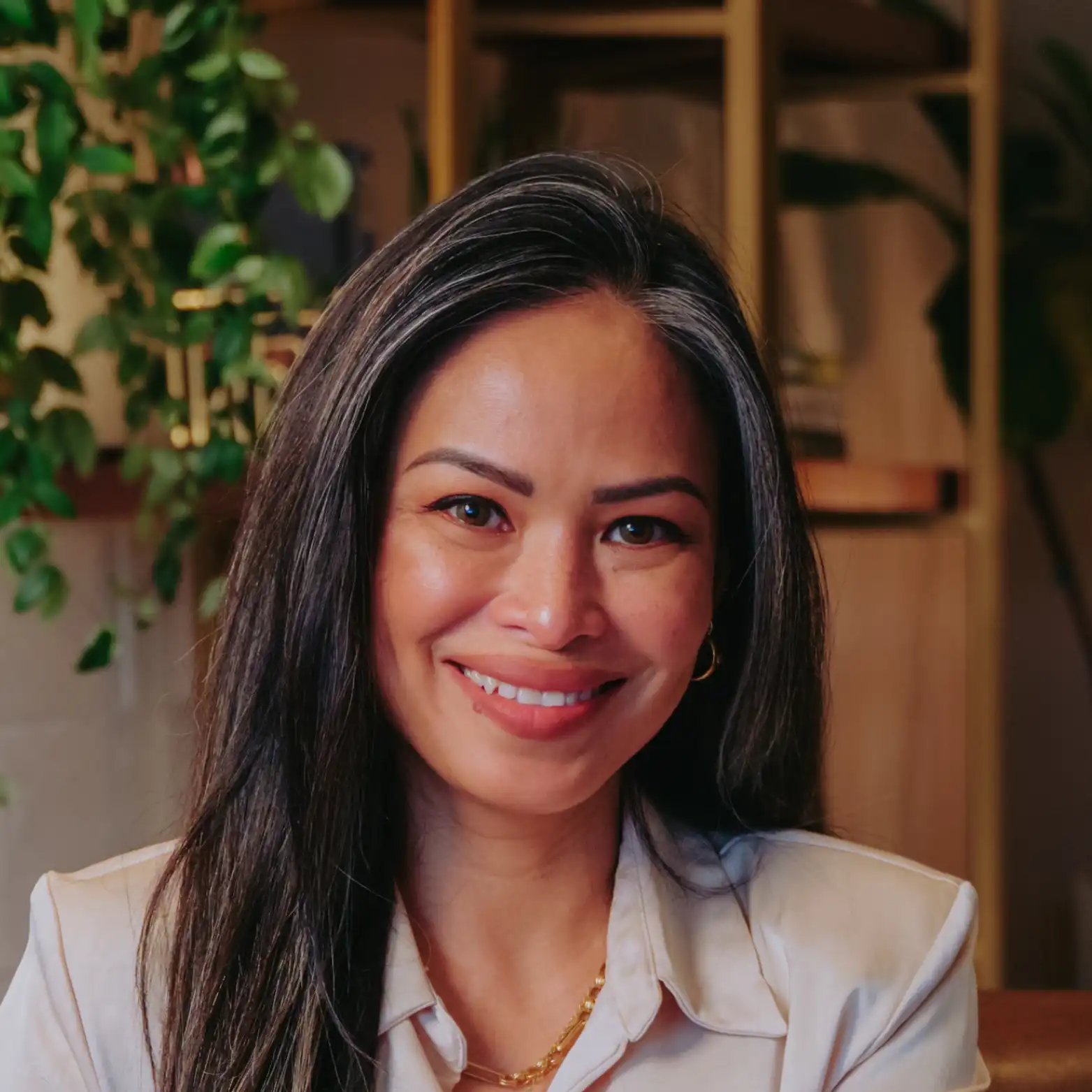
Grazel Garcia, LMFT
Licensed Marriage and Family Therapist, 15+ years. Certified EFT supervisor candidate. Specializes in interracial couples, LGBTQ+, trauma, grief, Brainspotting.

Sarah Liang, AMFT, APCC
Neurodiverse and queer-affirming therapist specializing in Emotionally-Focused Couples Therapy (EFCT). Relational, systems-informed approach.

Arami James, AMFT
Culturally responsive therapist working with individuals and couples on interracial and intercultural relationship dynamics — fostering understanding and connection.

Tiffany Cuevas, AMFT
LGBTQIA+ affirming therapist specializing in identity, relationships, and personal growth. Compassionate, non-judgmental space for couples exploring relationship dynamics.

Meet the Grayslate team
Click below to see all our current therapists along with their full profiles and specialties.
Questions
Questions About LGBTQIA+ Couples Therapy
Your Deserve This
Start With a Conversation
Reaching out for couples therapy can feel vulnerable, especially when you are not sure what will happen next.
We get it. You do not need to know which therapist, modality, or kind of support you need before you call. Tell Grayslate a little about what has been happening, and the team will help you find a therapist who fits your relationship.